Alibaba Launches AI Chip to Challenge Nvidia H20, Backed by China
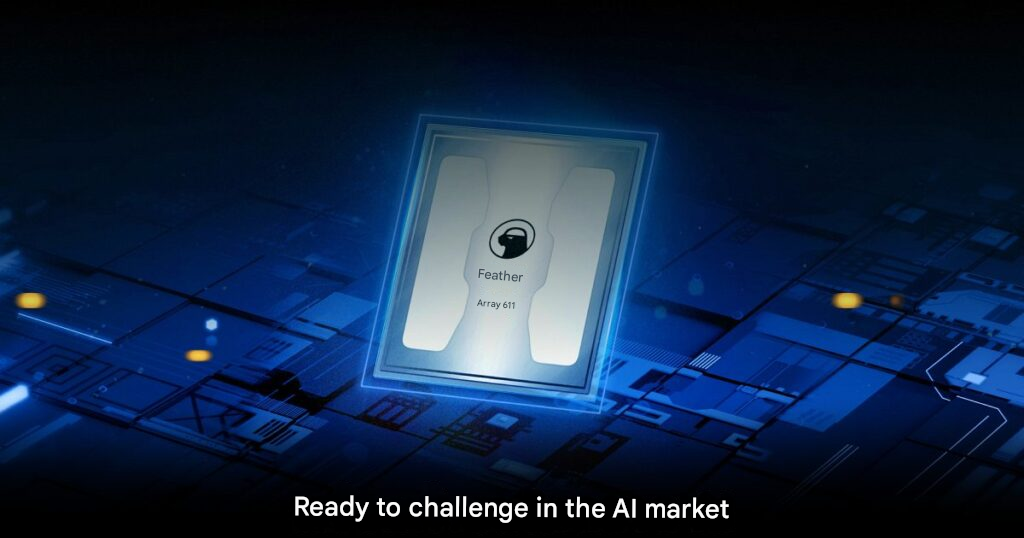
Alibaba has officially introduced a new AI chip developed by its semiconductor arm, T-Head, claiming performance comparable to Nvidia’s H20. Designed specifically for the Chinese market, the chip was showcased on September 16 during Premier Li Qiang’s visit to the Sanjiangyuan data center in Qinghai, broadcast through China’s state television CCTV. The demonstration compared Alibaba’s PPU against Nvidia H20, A800, and Huawei Ascend 910B, with results suggesting near-equivalent performance. However, detailed testing methodology has not yet been disclosed.
The PPU is an AI-focused ASIC equipped with 96 GB of HBM2e memory, inter-chip bandwidth of 700 GB/s, PCIe support, and a 400-watt power draw, according to specifications shown on CCTV and reported by the South China Morning Post. This marks the first public demonstration positioning Alibaba’s chip in the same league as Nvidia’s data center GPUs.
China Unicom has already deployed 16,384 of Alibaba’s PPUs at its Qinghai data center, accounting for more than half of the site’s 23,000 total accelerators. Together, these deliver 3,579 petaflops of computing power, with the facility expected to expand to 20,000 petaflops once fully completed.
The demonstration carries geopolitical weight as well as technical significance. Nvidia’s H20 was specifically engineered to comply with U.S. export restrictions limiting high-performance chip sales to China, based on Hopper architecture but with reduced specifications. By contrast, Alibaba’s PPU leverages 96 GB of HBM2e memory, appearing competitive in raw capacity, though real-world performance remains to be independently verified.
A key uncertainty remains in software compatibility. Alibaba has not disclosed details about frameworks, developer tools, or integration with existing AI model stacks. For now, claims of equivalence with Nvidia are supported primarily by Chinese state media, leaving the industry waiting for independent benchmarks and developer adoption before validation.
This development highlights China’s accelerating drive toward semiconductor self-sufficiency amid tightening U.S. restrictions on advanced technology exports. By advancing domestic AI chips, China not only demonstrates progress in high-performance computing but also signals intensifying competition in the global semiconductor industry.